- The Friday File
- Posts
- How to create a content calendar
How to create a content calendar

John McCoy
January 26, 2024
So, you’ve decided that digital marketing is your jam. You want to let the universe know you exist and start pushing content out into it. Take it from me: without a content calendar, you’re going to struggle.

I launched a website three years ago called www.johnmccoywrites.com. I think I posted maybe 5-6 articles on it over a year. After 12 months, I canceled web hosting and closed the website. My fatal flaw was a severe lack of a clear direction. Would a content calendar have fixed that? Maybe, maybe not. But it certainly would have provided a clear vision, which would have defined the project.
The point is you need to make a plan.
Define your objectives
What do you want to do with your content? Are you planning on using social media to drive the bulk of your traffic through social media? Or are you using a WordPress blog like this one to generate traffic?
Or is video your prime mover?
And what is your long game, anyway? Are you trying to sell a service like content or copywriting, or are you monetizing a blog through affiliates?
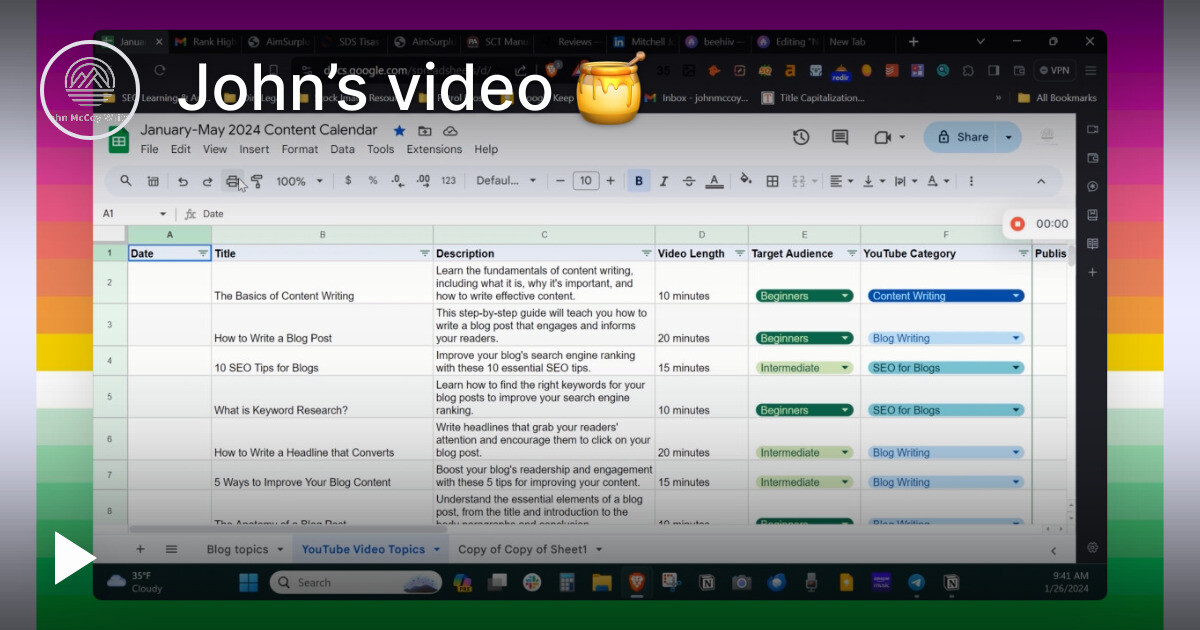
Choose a platform and create a template
It doesn’t matter what platform you use to create your drafts. The important thing is to be consistent. If you use Word, stick with it. Notion is pretty cool, so if you like it, stick with it. I do really like how simple it is to create a template in Notion, and the free version is excellent.
Of course, the Google Business Suite is my favorite, and it keeps getting better with time. But again, it does not matter that much which one you use; settle on one, create a reusable framework in the form of a template, and run with it.
Make sure to use something that has a calendar feature to keep track of your posting schedule.
Where do you intend to focus your efforts? While it is tempting to rely heavily and strictly on social media for your outreach, remember that your reach can get throttled in the blink of an eye. You can be deplatformed with no recourse whatsoever, so you could end up treading lightly.
That said, I still recommend using social media for reach. If you have an audience of one thousand followers, you basically have a cheat code to get eyeballs on your personal website or blog by sharing with them.
And finally, you should be doing as many channels as you reasonably can to maximize exposure, but not at the expense of quality. And remember this: always, always, always recycle your content. A single blog post is also:
your weekly newsletter.
3-4 LinkedIn posts
A couple of Twitter threads
Script for a YouTube video
You already did the legwork once. If you don’t reuse it, you are just ignorant.
Create content pillars or hubs
Now that you know where you’re going to keep tabs on your material and what you’re writing it on and have settled on your channels, it’s time to populate your calendar with ideas. Successful blogging is never the result of just throwing stuff at the wall to see what sticks; it is the product of careful and meticulous planning.
One of the best ways to prepare your blog is to create a master topic, which is your pillar or hub. It is the one overarching topic that your website revolves around. In the case of this website, it is about how to write content and use SEO to optimize content. The pillar piece is a broad overview of the topic, like “Blog & SEO Content Writing for Business” or something like that.
After the pillar piece is written (it is okay for it to be a long piece of content), you will want to break it down into smaller chunks that are much more granular in detail.
Generate spokes or clusters
The next step is the spokes or clusters. These are the pockets of content pieces that break down a broad pillar item. Oh, and going forward, about 90% of the time content refers to blog posts. Blogging sounds boring, and a lot of misinformed people will swear it is dead. It is not.
But anyway. To establish yourself as a topic authority, you’re going to write a lot about the same topic over and over again. This doesn’t mean you should copy and paste.No, it all needs to be fresh material. However, you need to find the material that is most important for your project and really break it down.
I have learned that after years of doing this on a full-time basis, your inspiration for further spoke articles generally comes from writing and researching previous ones. You’ll be researching something and find a rabbit hole that is too much for the current article, so it becomes a new article. Many such cases.
Keep plenty of evergreen content or topics around
Thankfully, after a year of content creation, you will have dozens of pieces to work with (assuming you stay consistent throughout the year). Some of the items may prove to be seasonal or situational, but a good chunk of it will be evergreen.
Make sure to create a swipe file of good evergreen topics to pull from when you need inspiration strike. And feel free to use these liberally; nobody remembers what you post nearly as well as you do.
Recycle the hell out of your work
Again, recycle your work. Take a good-performing tweet (as long as it’s not a shitpost) and expand on the idea into a thread. Cross-post the thread to LinkedIn. Send out chunks of your blog post to your email list. You get the point.
People really don’t pay attention to you that closely, especially when you are small and are trying to break out. This is the perfect time to attack all available channels and produce content like a loon. You need to get your name out there so that folks will have a concept of who you are and what you do. Nobody is going to promote you for you, so you had better get to it and do it on your own.
Parting thoughts
Bottom line up front (BLUF): you aren’t serious about content creation until you have a content calendar that you follow. Does it have to be followed religiously? It depends on your level of discipline. For me, I must follow it like the Bible.
With that said, it remains somewhat flexible because I may want to shuffle items around depending on what makes sense. Also, I need the flexibility to add items into the mix when an idea strikes. But otherwise, it stays rigid.
While you’re hear, make sure to check out my ebook on getting started on Upwork. If you know how to leverage it, Upwork is a great resource.